Learn
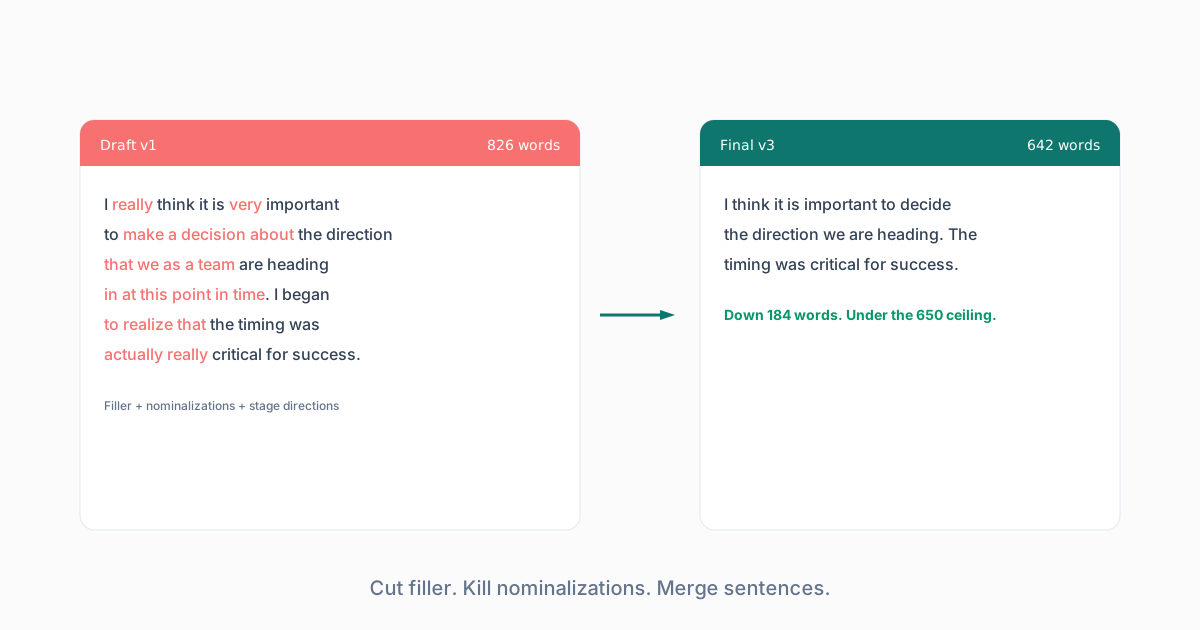
Purdue OWL and the UNC Writing Center both catalogue the filler + redundant-pair + nominalization patterns behind most overlong drafts. UNC Writing Center: conciseness handout.
Learn
How to Reduce an Essay Word Count
Working editor’s playbook: line, sentence, and structural cuts to get under a ceiling without losing the argument.
1. Delete filler words
The heaviest editors find 5 to 10 percent of any first draft is filler: really, very, just, actually, basically, that, in order to, at this point in time, due to the fact that. Do a find-and-replace pass. Every deletion is a word saved without cost.
2. Collapse redundant pairs
“End result” is “result.” “Past history” is “history.” “Final outcome” is “outcome.” “Free gift” is “gift.” These pairs are automatic; a single pass removes hundreds of words in a long essay.
3. Kill nominalizations
“Make a decision” is “decide.” “Conduct an investigation” is “investigate.” “Provide clarification” is “clarify.” Every nominalization saves 1 to 3 words and reads punchier.
4. Cut stage directions
“I began to realize that”, “It was at this moment that I understood”, “I remember thinking”: every one of these is a phrase pointing at the sentence you should have written. Delete them.
5. Merge sentences
Two short sentences sharing a subject can usually merge with a comma or semicolon. Two paragraphs on the same idea usually merge into one.
6. Cut the recap
Every essay has a sentence that summarizes the point you just made. Cut it. The reader has just read the sentence being recapped.
7. Structural cuts
If line-level cuts still leave you over, kill an entire paragraph. The paragraph that hurts the most to delete is usually the one to delete; it means you were emotionally attached, not that it was necessary.
Tools that speed the cut
Grammarly’s conciseness suggestions catch redundant pairs, nominalizations, and wordy phrasing at scale. It is worth the paid tier if you edit essays regularly. Grammarly Premium flags conciseness issues in real time.
Affiliate disclosure: the Grammarly link above pays a small commission if you subscribe.
Try the counter
Paste the essay into the live counter. Cut with the seven tactics above. Watch the count drop live.